
The Synoptic Problem
Part 3: The Other Suspects

Last week, I made the best case I could for Q. Briefly, Mark came first, and Matthew and Luke both used him, but Matthew and Luke also share a great deal of material that never appears in Mark at all, and Q is the traditional explanation for that material. I tried to be fair to it. I think I was fair to it. It is a serious theory, defended by serious people, and it is not going away just because I happen to disagree with it. But before we go any further, I want to pause on something I skated past rather quickly last time, which is that Q is not the only solution on the table. It has been the dominant solution for the best part of a century, certainly, and in many places it is still taught as though it were close to settled fact. But it has never been the only answer to the Synoptic Problem, and some of the alternatives are worth a brief look before we get to the one that I actually find persuasive. Partly this is a matter of fairness. Partly it is because seeing the other suspects helps clarify what is actually at stake in choosing between them.
The Augustinian hypothesis
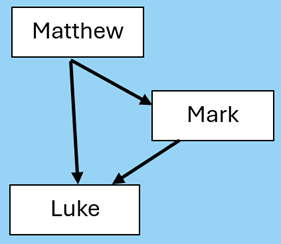
Let’s start with the oldest theory of all, sometimes called the Augustinian hypothesis, after Augustine of Hippo, who proposed something like it in the early fifth century. On this view, Matthew was written first. Mark then used Matthew, abbreviating him. Luke came third, and used both Matthew and Mark. This was, for many centuries, simply the assumed order, not because anyone had done careful comparative work on it, but because Matthew comes first in the New Testament, and Matthew was traditionally attributed to one of the Twelve. Tradition is not nothing, but it is not hard evidence either, and once scholars started actually comparing wording and structure, the Augustinian order ran into trouble. The pattern of agreement we looked at last week, the strong tendency for Matthew and Luke to follow Mark’s order and wording closely on the narrative material, but to diverge wildly in arrangement on the non-Markan material, makes much more sense if Mark came first and was a shared source for the other two, rather than if Mark was abbreviating Matthew. Why would someone summarising Matthew so consistently follow a different and rather erratic order for some material, while sticking rigidly to Matthew’s order for the rest? It is not impossible, but it requires more contortion than the alternative. The Augustinian hypothesis is not dead, exactly, but it has very few defenders left, and for understandable reasons.
The Griesbach hypothesis
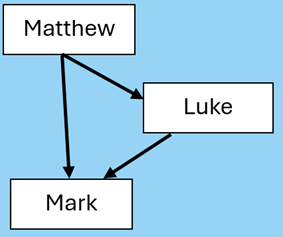
A more serious rival, and one still defended by a small but committed group of scholars today, is the Griesbach hypothesis, sometimes called the Two-Gospel hypothesis, after the eighteenth-century German scholar Johann Jakob Griesbach. This theory agrees with the Augustinian view that Matthew came first, but it puts Luke second, using Matthew, and has Mark coming third, conflating and abbreviating both Matthew and Luke. This is a cleverer theory than it might first sound, because it was specifically built to explain some of the patterns of agreement that Markan priority struggles with. There are places where Matthew and Luke agree against Mark even in passages all three share, which is awkward if Mark is the common source for that material. (We’ll come back to this. It’s a big deal, and – at least if I remember - it will be getting its own entry later in this series.) The Griesbach hypothesis explains these so-called minor agreements very neatly, because on this view Mark is simply drawing on both of the other two, and naturally preserves some material where they happen to agree.
The trouble is that the Griesbach hypothesis runs into a different and rather basic difficulty as in that it has a hard time explaining why on earth Mark exists at all. If a writer had Matthew and Luke both open in front of him, why would he produce something so much shorter, omitting so much wonderful material (the Sermon on the Mount! The Lord’s Prayer! The Beatitudes!), while keeping in things that seem almost like the rougher, less polished version of stories found in the other two? It is not impossible that an editor might work this way for some specific theological or pastoral reason of his own, and defenders of Griesbach do propose such reasons, but it asks us to imagine a fairly strange editorial mind. Most scholars, even those who are uneasy about Q, have not found this persuasive enough to give up Markan priority.
Here be dragons…

(A cute dragon image produced by AI. I originally had something rather more scary in mind, but I like it).
There are other proposals too, more technical still. These are theories involving multiple stages of editing, or hypothetical proto-Gospels behind even Mark, or various permutations in which two of the Synoptics might have shared an intermediate, now-lost source distinct from Q. Some of this gets genuinely intricate, the kind of thing that fills entire monographs with charts and sigla, and I do not propose to walk through all of it here. The honest summary is that once you start trying to explain the data, there is no shortage of imaginative ways to do it, and not all of them are very convincing. In some form though, they have one of the main theories as their base theory on which they build. So learn the basics, and then you can get all fancy.
The Farrer hypothesis
And all of this brings me to the theory I do find convincing, and which will occupy the rest of this series. It goes by a few names, the Farrer hypothesis, sometimes the Farrer-Goulder theory, sometimes, in its modern form, the Farrer-Goulder-Goodacre theory. (Apologies to anyone who finds this getting needlessly cluttered. Biblical scholars are not known for snappy naming conventions. It seems odd that ‘Q’ gets away with being a single, mysterious letter.) Austin Farrer floated the idea in a 1955 essay ‘On Dispensing with Q’. Michael Goulder developed it at considerable length in the decades that followed. And in recent years its most visible advocate has been Mark Goodacre, whose work I’ll be drawing on quite heavily as this series goes on, not least because he makes the case better than anyone else currently writing. And I’ll be throwing in my own take on things too.
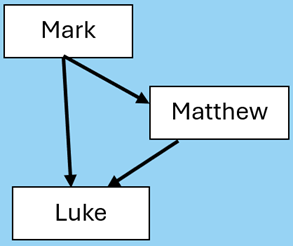
The basic claim is disarmingly simple, especially compared to some of the alternatives above. Mark was written first, just as the mainstream view holds. Matthew used Mark, expanding and supplementing him. And then Luke, third in line, used both Mark and Matthew. There is no Q. There is no lost document, because it was never in existence. There is no need to posit anything we cannot independently verify ever existed. Everything Matthew and Luke share that is absent from Mark is shared for the most ordinary reason imaginable: Luke had read Matthew, and used him, the way any attentive author makes use of a predecessor’s work.
Why does this matter so much to me, and why am I going to spend several more weeks defending it? Partly because of the sheer economy of the explanation. It solves the same puzzle as Q while requiring one fewer document, a document that, conveniently, nobody has ever seen. But mostly because personally I think the alternative theories, including Q, have tended to smuggle in an assumption that does not survive close inspection, that Luke was somehow incapable of creatively reworking a written predecessor, and so any divergence from Matthew must point to a different source rather than to Luke’s own hand at work. Once you take seriously that Luke was a skilled, purposeful writer, fully capable of rearranging, redistributing, and reworking material he had in front of him, a great deal of the supposed evidence for Q starts to look like evidence for something else entirely. It looks as if Luke was reading Matthew, and doing what good authors do with their sources.
That is the theory I want to spend the rest of this series defending properly, starting next time with the basic case for it, before we get into the specific evidence. In subsequent weeks, I plan to write on (1) the Sermon on the Mount and its scattering across Luke’s travel narrative, (2) a rather under-discussed swap of Magi for shepherds, (3) something often called the ‘minor agreements’, and (4) the curious phenomenon Marc Goodacre call ‘editorial fatigue’. I’m not 100% sure of what order I’ll do all of this in yet, but it’s the beginnings of a plan… There is a good deal of detective work still to come.
Makes sense. I look forward to more!