
The Synoptic Problem Part 2: The Case for Q

Last week, I set out the basic shape of the Synoptic Problem. Matthew, Mark, and Luke share so much material, often in the same order and sometimes in identical wording, that the similarities cannot easily be put down to coincidence. We also saw that most scholars now think Mark came first, and that Matthew and Luke both used it. But that left a loose thread dangling. If Mark was the common source for the narrative material, where did Matthew and Luke get all the other material they share, the material that never appears in Mark at all? This week, I want to take that loose thread and follow it properly, because I think it’s important to understand just how reasonable the answer is before I start pulling it apart in later entries. The hypothetical document at the centre of the answer is called Q (which, as I mentioned last week is from the German word Quelle meaning ‘source’) and I want to make the best case for it that I can. Not because I ultimately agree with it, but because plenty of careful, intelligent people have found it convincing, and it deserves to be understood on its own terms before anyone starts taking shots at it.
So let’s start with what is actually being claimed. The Q hypothesis says that, alongside Mark, both Matthew and Luke each had access to a second written source. This document contained mostly sayings of Jesus. In other words, it was a document of Jesus’ teaching material, parables, and short pronouncements, that sort of thing. It is not a narrative Gospel in the way Mark is. In other words, it does not tell a story as such, but was simply a collection of sayings. Because it was not narrative, it missed out some key things that are the Gospels that we know. For example, it does not appear to have included an account of Jesus’s death or resurrection. There is a possibility that it had some light narrative to hold the saying together, but the narrative was certainly not developed. The idea is that both Matthew and Luke had a copy. Both drew on it independently, weaving it into their own version of events. Neither tells us they are doing this, because neither expected to be read alongside the other two thousand years later by people picking apart their footnotes.
Why would anyone propose something so specific about a document nobody has seen? The answer lies in the pattern of the evidence, and the pattern really is striking once you look closely. Consider the material that Matthew and Luke share but Mark does not contain. The Lord’s Prayer is a good example. Both Matthew and Luke include a version of it. The wording is not identical, but it is close enough that the two versions are clearly related in some way. The relationship is too close for coincidence, but also too different for one to simply have been copying from the other. Or take the temptation narrative, where Jesus is tested in the wilderness. Mark mentions that this event happened, but has no further details. But both Matthew and Luke give an account of Jesus’ temptation in some detail, with several of the same scriptural quotations used in the same way to rebuff the same temptations. But again, the stories also contain a lot of differences, leading many to conclude that they are not directly related. And there are many other such examples. None of this material appears in Mark. So if Matthew and Luke are not getting it from Mark, and if Luke was not simply copying Matthew, nor Matthew from Luke, because the text is too different for that to be convincing, then where is it coming from?
This is where the elegance of the Q hypothesis becomes apparent. It offers a single, tidy explanation for a whole category of material. Rather than needing several different explanations for several different patches of shared material, Q accounts for all of it at once. One lost document, used independently by two authors, explains why this material turns up in both Gospels with such similar wording, and why it is absent from the one Gospel that came earlier. Simply, both Luke and Matthew drew on Q (as well as Mark), editing and using it slightly different ways.
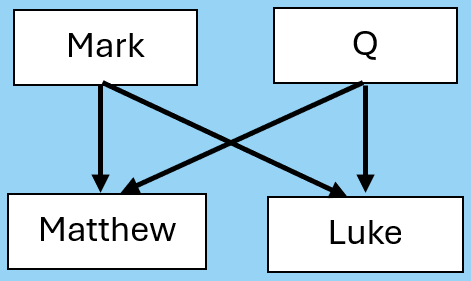
Diagram showing the use of Mark and Q by Matthew and Luke. This is a simplified picture as both Matthew and Luke will have used other sources too, giving rise to material unique to their texts.
There is something else worth noticing too, which is the kind of material we are talking about. By and large, the Q material is teaching, not narrative. It contains sayings, parables, ethical instruction, prophetic warning. It does not contain miracle stories (of the sort Mark is full of) and it does not contain a passion narrative. This is not a trivial observation. Early Christianity was not short of collections of sayings. We know, for instance, that texts like the Gospel of Thomas exist precisely in this ‘sayings collection’ genre, with no narrative framework attached to them at all. So the idea that an early community might have circulated a collection of Jesus’s teaching, distinct from any account of his death and resurrection, is not some strange ad hoc invention dreamed up to rescue a wobbly theory. It fits a known pattern of how some early Christian material circulated. (If you want to see the content of the Gospel of Thomas, helpfully laid alongside the four ‘canonical’ gospels, visit https://sites.utoronto.ca/religion/synopsis/meta-5g.htm)
There is also a more technical argument, the kind that tends to convince scholars even when it leaves everyone else faintly baffled, usually referred to as the argument from order. When Matthew and Luke are both drawing on Mark, they tend to follow Mark’s sequence of events quite closely, even when they are also editing his Greek or adding extra detail. But when it comes to the material they share that is not from Mark, the order is far less consistent. Matthew tends to group similar teaching together into long blocks, such as the Sermon on the Mount. Luke, on the other hand, spreads similar material out across his Gospel in smaller pieces, on what is often called the ‘travel narrative,’ as Jesus journeys towards Jerusalem. If Luke had simply been copying Matthew directly, we might expect him to follow Matthew’s order for this material in much the same way that both Gospels follow Mark’s order for narrative material. Instead, the order is scrambled. One explanation for this is that Matthew and Luke were each freely arranging material drawn from a shared source, a source that did not impose a fixed sequence on them the way that a finished, narratively ordered Gospel like Mark did. That is exactly the kind of behaviour we would expect if both were working from something more like a loose collection of sayings, which each evangelist felt free to organise according to his own purposes.
Put this all together and you can see why the hypothesis took hold. It explains the shared material economically. It fits the literary genre of other known early Christian writings (e.g. The Gospel of Thomas). It accounts for the otherwise puzzling pattern of agreement and disagreement in sequence. None of this required scholars to find an actual manuscript of Q. The case was built from internal literary evidence.
It is also worth saying, in fairness to the theory, that Q is not meant to be a wild speculative leap. Once you accept Markan priority, accept that Luke probably did not know Matthew directly, and look honestly at the pattern of shared but non-Markan material, something like Q becomes a natural inference. You do not need to assume anything exotic about the early church. You simply need to assume that early Christian communities wrote things down, that more than one of these things circulated, and that not everything written down in the first century survived to the present day. Given how much we know was lost from the ancient world generally, that is hardly the most outlandish assumption that could be made.
Scholars who hold to Q are not naive enthusiasts overreaching from thin evidence. Many of them are cautious, careful people who have spent entire careers testing the theory against the alternatives and found it the most economical fit for what we actually have in front of us. Q has been refined, debated, and revised over more than a century of sustained scholarly attention, and it has survived that attention. That alone should give us pause before dismissing it lightly. So that is the case for Q, built as fairly as I can build it in a short time. It is not a theory built on nothing. It rests on a real and well-documented pattern in the texts, it draws on a known genre of early Christian literature, and it solves a genuine literary puzzle with a pleasing economy.
Nevertheless, although many scholars accept the existence of Q, it has never commanded universal acceptance. Other answers have also been proposed. Next time, I’ll outline another theory and begin to say why I find it more persuasive than the Q hypothesis. Then, over subsequent weeks, I’ll dive into some specific aspects of this.